

Investment casting and sand casting both pour molten metal into a mold, but they suit very different parts. The right choice depends on part size, geometry, tolerance, alloy and order quantity. This guide compares the two processes from a buyer’s point of view.
How the Two Processes Differ
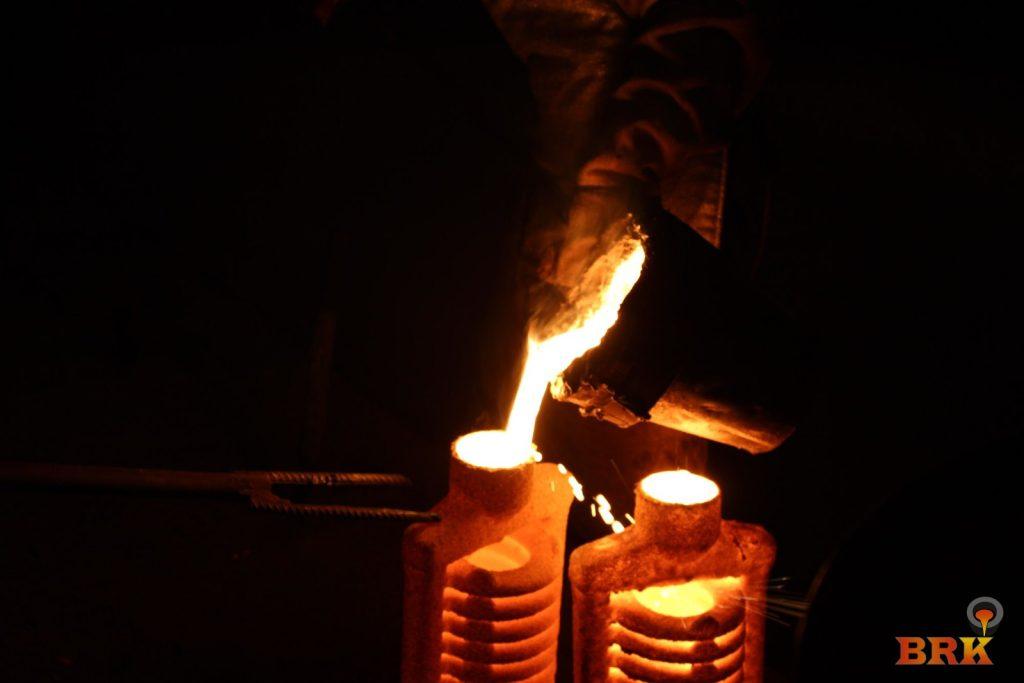
In investment casting, a wax pattern is injected into a metal die, coated with ceramic slurry and melted out. Metal is poured into the fired ceramic shell, which is broken away after cooling. A new pattern and shell are needed for each cast part.
In sand casting, a pattern forms a cavity in compacted sand. The mold usually splits along a parting line, and cores create internal shapes. The sand mold is also destroyed after each pour, but the pattern can be reused.
Side-by-Side Comparison
| Criterion | Investment casting | Sand casting |
|---|---|---|
| Typical part size | Small to medium parts | Small to very large parts |
| Dimensional accuracy | High | Lower, larger machining allowances |
| Surface finish | Smooth | Rougher, follows the sand grain |
| Thin walls and fine detail | Very good | Limited |
| Parting line | Wax pattern has one; the shell has none | Present on the casting, along with draft |
| Tooling cost | Higher (wax injection die) | Usually lower |
| Cost per kg | Higher | Lower |
| Machining after casting | Often reduced or limited to key features | Usually more |
When to Choose Investment Casting
- The geometry is complex, with internal shapes, undercuts or fine details.
- Machining the part from solid would waste a lot of material or time.
- Tight tolerances are needed. European buyers often specify VDG P690 tolerance classes.
- The part is small and is ordered repeatedly, so tooling cost spreads across the volume.
- Several machined or welded pieces can be combined into one casting.
When to Choose Sand Casting
- The part is very large or heavy.
- Tolerances are general and surfaces will be machined anyway.
- The geometry is simple and the budget for tooling is limited.
Look at Total Part Cost
A comparison based only on price per kilogram can mislead. A sand casting may need more machining, and it may need several parts joined together. An investment casting can cut those steps, so its finished cost may be lower even when its casting price is higher. Compare the cost of the finished, inspected part.
What BRK Metal Casts
BRK Metal is an investment casting foundry in Turkey, working since 2002. We cast parts from 1 g to 25 kg in stainless steel, carbon and low-alloy steel, aluminum, bronze and magnesium. Send us your drawing and we will review which route fits your part.