


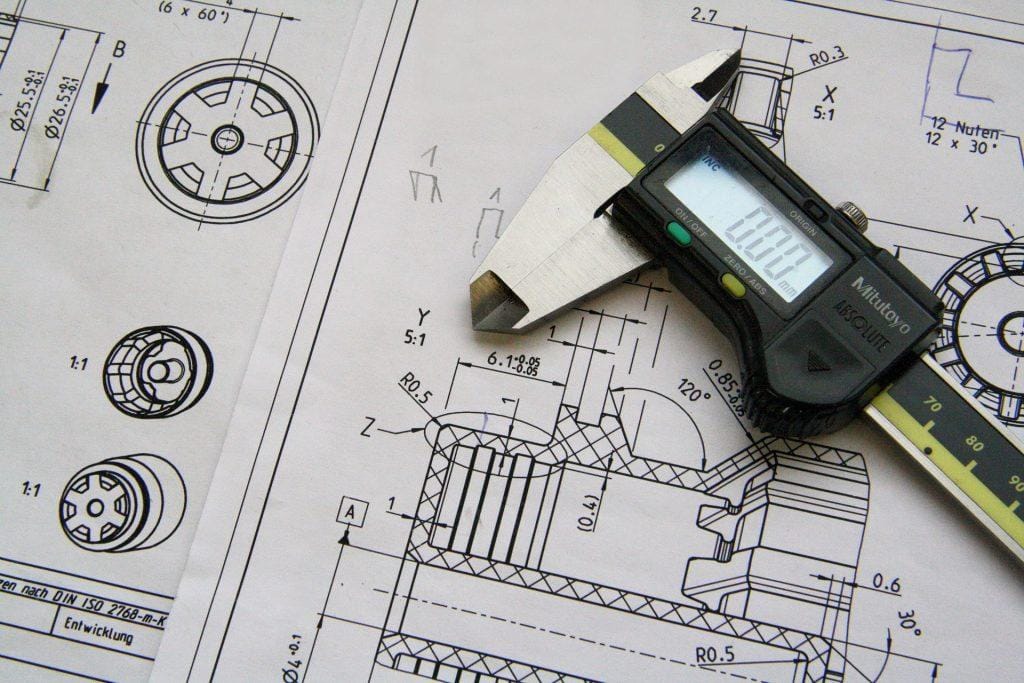
If you buy investment castings for European customers, you will see VDG P690 on drawings and in requests for quotation. This guide explains what the standard covers, how its tolerance classes differ, and how to specify them on a drawing.
What Is VDG P690?
VDG P690 is a reference sheet of the German foundry industry, now published by the BDG (formerly VDG). It sets general dimensional tolerances for investment castings, so a buyer and a foundry can agree on accuracy without listing a tolerance for every dimension. It is widely used in Europe, especially where parts are specified to German practice.
Tolerance Classes D1, D2 and D3
| Class | Meaning | Typical use |
|---|---|---|
| D1 | Standard tolerances | Dimensions without a stated tolerance |
| D2 | Precision tolerances | Dimensions toleranced on the drawing |
| D3 | Extremely precise tolerances | Individual dimensions, by agreement with the foundry |
D3 is the tightest class, not D1. A common mistake is to assume that a lower number means a closer tolerance. The exact values depend on the nominal dimension and are given in the data sheet. Our dimensions and tolerances page shows the table we work to.
Why Not Specify D3 Everywhere?
Every investment casting shrinks as wax and metal cool, and the ceramic shell also moves slightly during firing. The foundry controls these effects, but each extra level of accuracy adds tooling corrections, process control and inspection. For that reason D3 is meant for a limited number of dimensions. Applying it to a whole part raises cost without adding function.
How to Specify VDG P690 on a Drawing
- State the general tolerance class in the title block, for example D1.
- Mark only the functional dimensions that need D2 or D3.
- Identify the datum features the foundry should measure from.
- Show which surfaces will be machined after casting, and add the machining allowance.
- Discuss critical dimensions with the foundry before the tooling is made.
What Affects the Achievable Tolerance?
Part size has the largest effect, because shrinkage grows with length. Wall thickness changes matter too, since heavy and thin sections cool at different rates. Alloy, gating design and heat treatment also influence the final dimensions. You can read how each step works on our investment casting process page.
VDG P690 at BRK Metal
BRK Metal can cast to D3, the tightest class of VDG P690, and uses D1 as the default for general dimensions. We cast parts from 1 g to 25 kg in 4140, 304 and 316 stainless steel and low-carbon steels. See our investment casting services, or send your drawing through our contact page for a review.
Frequently Asked Questions
Which VDG P690 class is the most precise?
D3 is the most precise class. D1 is the standard class and D2 sits between them.
Can a whole part be made to D3?
D3 is intended for a limited number of dimensions or surfaces. Discuss the requirement with your foundry before tooling.